Cathedrals of joy: games as a gate to sovereignty
Why great games matter in dark times.
By Joost Vervoort
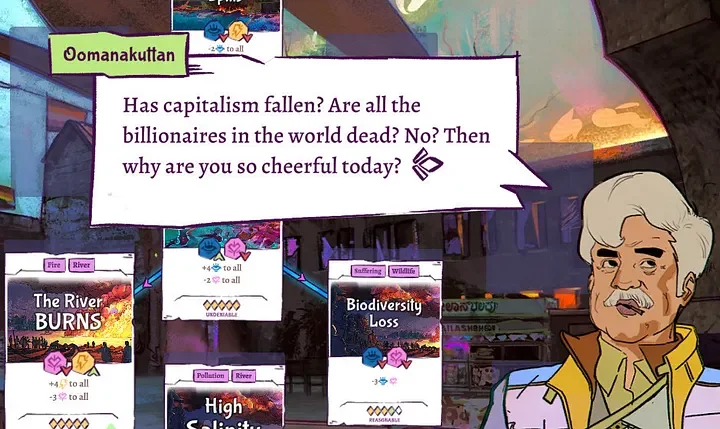
In our game All Will Rise, you play card battles as conversations in your struggle to bring a corporation to court for destroying the river that flows through your city of Muziris in South India. Oomanakuttan is one of the people you’ll battle — he’s on your side of the issue, but also a grumpy old sceptic.
Some time ago, Volha Kapitonava, former Disco Elysium community manager and managing director for ecogame The Regreening, wrote a wonderful blog post titled ‘Joy is the radical tool games need to turn eco-anxiety into agency’. She wrote about the importance of joy in games that try to engage with the problems of ecological destruction. She mentioned our game All Will Rise, a role playing game about taking billionaires to court for destroying the planet, as an example.
I wholeheartedly agreed with this perspective, and it prompted me to try and write down my own thoughts about the importance of joy in games and in life, and how this informs our thinking about All Will Rise.
My friend Rosa Lewis is a meditation teacher who also works with different psychological models, argues that joy is the gate to sovereignty. We’ve worked with this a lot, and it’s been eye opening. See, previously my sense was that sovereignty was all about saying no, drawing boundaries, and, of course, in some way it is. But, there’s a subtle distinction where drawing boundaries is more about maintaining separateness and independence from the influence and demands of others. The link from joy to sovereignty works differently. When you learn what you really enjoy, as specifically as possible, you learn about your own actual desires and preferences in a way that many of us don’t seem to connect to much. At least for me, I discovered that I was not super aware of my own capacity for joy in the past. Work responsibilities and a quest for a meaningful, impactful existence was eating up all my time and energy. A meaningful life, but not particularly joyful.
So I started to write down lots of little things that I enjoy. And, it turns out, not a lot of it has to do with work or achievement. Most of it is little moments with friends and people I love, at festivals, in a quiet bar. A lot of transition moments between day and evening or night and morning. As I started to develop more of a sense of what actually brings me joy, it also became easier to recognize how I was spending my time in joylessness. It made it much easier for me to make decisions in work and personal contexts that followed that sense of joy. Working on All Will Rise is certainly one of them.
Building a game is sometimes compared to building a cathedral — so much work goes into it, and it takes years. This cathedral metaphor made me think. There is obviously a way to engage with games that is very joyless — playing bad games or playing games just to numb out or to escape in a mindless way. But the best games are, I think, accurately described as ‘cathedrals of joy’. This first came to mind for me when I was playing Baldur’s Gate 3 when it first came out — if there ever was a game for which ‘cathedral of joy’ is an apt description, this is it. I’m replaying BG3 with my new love and it’s even more completely joyous. But at the time I was playing BG3, the genocide in Gaza was also starting — and it made me really question what the justification could be for having things of such joy in a world with such suffering. As the genocide continues in an only slightly covert way and thousands are murdered in Iran and horrors are happening in Sudan and Congo, the same painful sense comes up. Part of the answer is that we need examples of how truly good life can be when creativity and play are allowed to be. And when we play games consciously rather than in that numbed out way, they can be so joyous. And joy supports sovereignty.
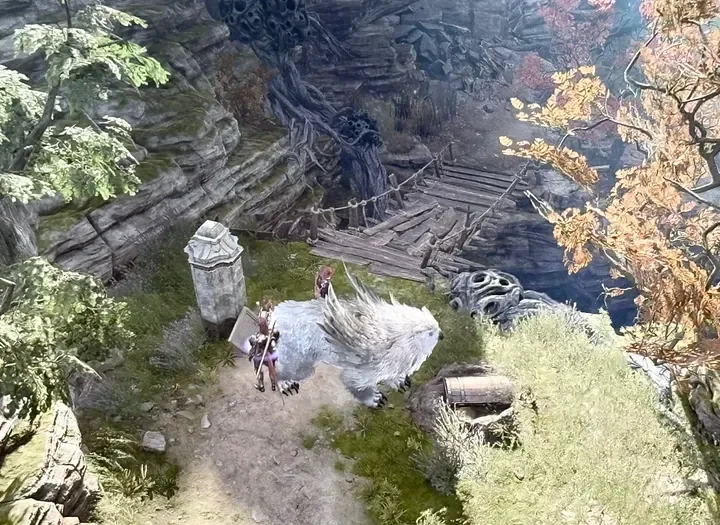
Playing Baldur’s Gate 3 together on the couch (PS5). My girlfriend was overjoyed when she found out that as a level 6 Druid, she can actually turn into an owlbear, especially after we saved an owlbear pup who now lives at our camp.
This is a core principle of how we’re thinking about All Will Rise. Our game deals with a small team of activists who are trying to take on corporations and billionaires for destroying a river in the speculative city of Muziris in Kerala, South India. While activists’ struggles can be dramatic, exciting, and full of intense politics, they can also be heavy, full of anger and sadness. We decided to make a game that is ‘inappropriately joyous’ in the face of all this. How can the game be an injection of wild, playful energy, full of inspiring, funny and crazy possibilities? We started with our protagonist, Kuyili. Kuyili is enthusiastic and humorous. She sees possibilities and absurd situations everywhere. This is partly her genius, and partly her cope — other characters sometimes call her out for being frivolous or too much like a ‘game player’ in the face of real hardships, which is, of course, ironic given that we control her as the players. Through Kuyili and the ways she encounters the world, we want to show how it is powerful to be both deeply playful and deeply serious — and that these two things are not opposites, but complementary.
This is something I’ve been writing about for a long time, but it’s so cool to see it take shape in our game. In fact, a lot of the game’s humor comes from Kuyili clashing with much more serious characters, like the grumpy old activist Oomanakuttan, who acts as a kind of frenemy, or her tough and target-oriented team mate Joy. But deep playfulness and deep seriousness run throughout the game’s world. Fisherman and community leader Shabeer has suffered real hardships because of the river dying, but he has an absurd and humorous streak in the way he veers off topic to photographs of his daughters or to weird conspiracy theories. It’s possible to see the spiritual-level ecological destruction in Muziris everywhere; but it’s also possible to get (too) drunk with the locals. One thing I’ve learned from Rosa is to embrace ‘dark joy’ — finding joy in weird, inappropriate and difficult things. All Will Rise is certainly full of juicy, dark joy. With this approach and tone, we are going directly against a lot of media engaging with ecological destruction, which tends to have a kind of serious, finger-pointing vibe. We don’t think that’s helpful.
Cathedrals are built as monuments to the divine, emanating seriousness. Games can be playful cathedrals, monuments to joy. We hope that in All Will Rise, joy is a gate to sovereignty, and everyone gets to cultivate their inner Kuyili a bit. One main goal of the game is, after all, not to convince people that ‘corporations = bad!’ or something like that. Instead, we hope to show that even though it can be difficult to take on the powerful, it can be very joyous as well — gratifying, inspiring, and sometimes funny as hell. Real activists will tell you the same thing.
All Will Rise is launching its kickstarter soon, and we’d love for you to add to the joyousness of it all by supporting us! We’ve already been featured in the Guardian, by Wholesome Direct and in games media like PC Gamer and IGN, so we’re hopeful for success! Find the kickstarter here! We’re also supporting this line of thinking in the EU project STRATEGIES.
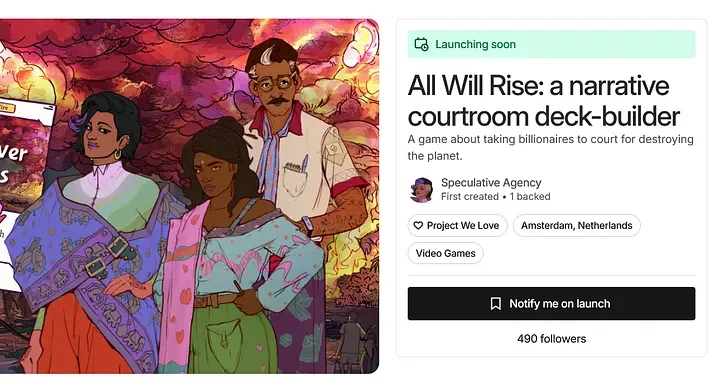
Getting ready to launch our Kickstarter for All Will Rise in a few weeks, follow us now!
Dr. Joost Vervoort is an Associate Professor of Transformative Imagination at Utrecht University and Impact Director for All Will Rise. His work focuses on connecting games and creative practices, mystery, politics and action to create better futures. He leads the NWO Vidi project Anticiplay and is a leading researcher on the Horizon Europe project STRATEGIES which focuses on the transformation of the European game industry. He co-leads the pluralistic meditation group the Dharmagarage, sings about the global crisis in Terzij de Horde and paints weirdly dark album covers for other bands.