
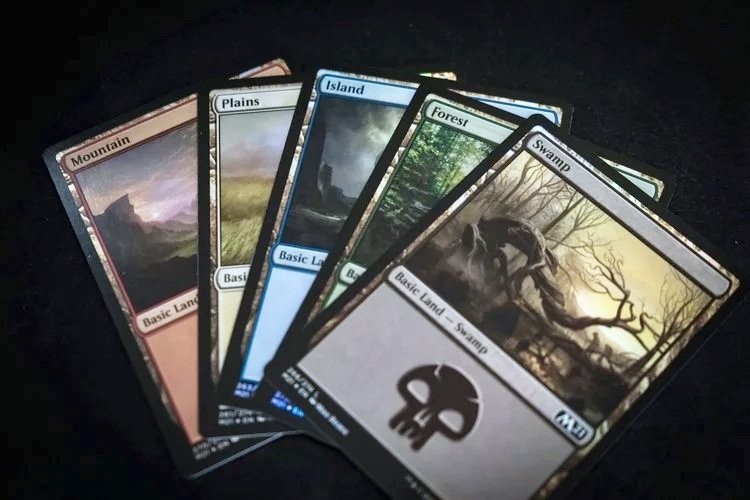
Franchise Hacking Toolkit
Make your own Magic: The Gathering Eco-Themed Card Decks
Welcome to our Toolkit!
This toolkit explains how to set up the Magic: The Gathering (M:TG) Hacking Toolkit and how to get started with ‘franchise hacking’ using the sample deck provided. It briefly explains selected aspects of the core M:TG gameplay but does not explain how the game works from the ground up.
The are many video tutorials and other online resources that participants can use to learn the fundamentals of the game. Check out this basic introduction from The Command Zone, a YouTube channel associated with the company behind M:TG, Wizards of the Coast. It provides a useful starting point and can be assigned for preparatory watching before utilizing the M:TG Franchise Hacking Toolkit in a workshop or course.
Franchise Hacking Toolkit
by Stefan Werning
with Laura op de Beke, Timo Fluitsma, Chloé Germaine, and Paul Wake
This toolkit provides you with the technical and conceptual materials to ‘hack’ game franchises with a focus on fostering inclusive climate communication and education, using the popular trading card game franchise Magic: The Gathering (1993) (M:TG) as a case study. It is made available here on a Creative Commons Attribution 4.0 International License. Full details of the license, and all the files are available on Zenodo.
Suggested Citation: Werning, S. (2026). Magic: The Gathering - Franchise Hacking Toolkit. STRATEGIES. https://zenodo.org/records/18682597
Franchise Logic
The term ‘media franchising’ and the impact of franchise logic on the media industries have been central e.g. in the work of Derek Johnson (2013), who mobilizes the concept to highlight how transmedia story worlds like Star Wars or the Marvel MCU and the corporations behind them gradually monopolize mainstream media attention through processes comparable to those of non-media franchises like McDonald’s or UPS.
Through their cultural omnipresence, adaptability and longevity, successful media franchises – including game franchises like Nintendo’s Super Mario and Epic Games’ Fortnite but also analogue game franchises like Monopoly and M:TG – often become the object of intense, collectively practiced fandom and deep emotional as well as cognitive engagement. From an educational perspective, these fandoms can be defined with James Paul Gee as “affinity spaces” that provide a foundation for lasting, personally meaningful engagement.
A game franchise as complex and malleable as MTG allows for critiquing existing but also imagining alternative economic, social and/or political systems
For example, Jason Bainbridge has explored the Pokémon franchise specifically in relation to ecological thinking among (younger) players and defines it as a “vernacular theory”, a shared conceptual framework that shapes how players envision concepts like environmentalism, interspecies coexistence and materialism. The term vernacular thereby points to the outreach of and affective investment in media/game franchises, which vastly surpasses that of individual games and particularly so-called ‘serious games’.
The method of franchise hacking builds on the work of Johnson and Bainbridge but specifically asks how we can actively co-create and ‘hijack’ the cultural impact of game franchises not for persuasion but for fostering equitable communication about climate threats and sustainable futures on the basis of shared fandom and ‘vernacular’.
The broader hacking method is outlined in our STRATEGIES Games Hacking Education Report, which includes examples of our previous MTG hacks.
The Hacking Method
Drawing on previous work by Chloé Germaine and Paul Wake on ‘hacking’ board games, the toolkit provided here allows players to ‘hack’ the M:TG franchise, not to detract from its core mechanics or gameplay but to thread an urgent narrative focused on environmental preservation and sustainability into the core of the game’s experience.
Following the ethos of hacking, franchise hacking seeks to hijack the core mechanics of a franchise to narrate fresh stories, engaging deeply with the game’s language — a language that the fan base comprehends and appreciates intimately. By subtly modifying flavour texts, names, mechanics, strategies, goals, and artwork, we craft our own cards, thereby sculpting a new story world that draws attention to real-world ecological phenomena and challenges.
Creating a New MTG Deck Using the Spreadsheet
Create a copy of the Google Sheet used for demonstration purposes by opening this URL (https://tinyurl.com/MTGsheetcopy) and clicking on ‘Make a copy.’ Tis creates and opens a new Google Sheet document with twelve sample cards, one for each main MTG card type the toolkit supports. Next, click on ‘Share’ in the top-right corner and, under ‘general access’, change ‘restricted’ to ‘anyone with the link’; finally, change ‘viewer’ to ‘editor’ and click ‘done’ to complete this step.
To make the Google Sheet accessible to NanDeck, click on ‘File’ ‘Share’ ‘Publish to web’; in the following menu, change ‘Web page’ to ‘Microsoft Excel’ and click ‘Publish’ to complete this process.
In the URL of the Google Sheet, copy the part of the address between “/d/” and “/edit?”; this string of characters identifies your Google Sheet together with the name of the worksheet (which is “testsheet” by default) and both need to be referenced in your NanDeck script.
Back in NanDeck, in the M:TG deck script, find line 5; it reads:
LINK="1kTbaPUoiDYDg1xi6Hir2jg1jzMtuW4a4K8-yjz-IICI!testsheet"
The part between the quotation marks points NanDeck to your Google Sheet and is split into two parts, separated by the exclamation mark (“!”) character. The first part is the string of characters obtained from the Google Sheet URL. The second part is the name of the worksheet. Thus, replace both with the information obtained above (10.) to link to your own Google Sheet.From now on, any changes you make in your Google Sheet will be reflected in the cards you build using NanDeck and you will only use NanDeck to build your card decks rather than changing anything else in the code. After having created a deck in NanDeck, you can
click on ‘Save images’ to export all cards as separate images. These can be imported into a virtual playtesting environment like Tabletop Playground, Virtualtabletop.io or Tabletop Simulator (this is particularly useful while the design of the cards/decks is not yet finished).
click on ‘Print deck’ to print the whole deck either into a PDF file (to share as a print&play document) or directly via a printer. This arranges the cards in a grid on a DIN A4 page so that they can easily be cut out. The size is equivalent to a regular MTG card, i.e. the cards fit into regular sleeves for MTG cards to improve the physical playtesting experience.
Instructions, Installation and Set-up
Please note: As the cards are created from a custom Google Sheet by default, a Google account is required for the preferred way to use this toolkit. An alternative, based on a static Excel sheet, will be outlined below; however, this option does not afford simultaneous editing by multiple users.
Basic Installation and Set-up
Unzip the contents of the M:TG Hacking Toolkit ZIP archive into a dedicated folder. The files are available on Zenodo.
Open the folder “Magic – Fonts” and install the following fonts by double-clicking on the respective TTF file and then clicking ‘Install’ Matrix Bold, Mplantin, and Beleren-bold_P1.01.
Open NanDeck by double-clicking on the application in the main folder.
In NanDeck, click ‘Open deck’ and select the file “MTG_deck_v1-0.txt”; this is the standard script that generates a card deck based on a correctly formatted Google Sheet.
Under ‘Config’, the “Validate & Build buttons” should be set to “One button” by default; if not, activate “One button” to enable simultaneous validation and building.
By clicking “Validate+Build”, you can run the script and generate the sample deck of cards in NanDeck. This deck contains 11 cards, one for each type currently supported in the toolkit. After completing the build process, you can flip through the cards via the arrow buttons in the preview view on the right.
The main card images (NOT the visual card elements like the background or symbols) are specified by a URL in the deck and are dynamically downloaded the first time a deck is built (which takes longer than a regular build process). You will see confirmation of this happening in the debug window at the bottom of the NanDeck UI. By default, all images are loaded into the main folder; while working on the deck, they should remain in the folder to speed up subsequent builds. However, after finishing a deck, all downloaded card images can safely be deleted from the main folder.
This completes the basic installation and setup; below, the steps for creating and linking a custom Google Sheet to design a new card deck will be explained.
Please note:
Unless you plan to create a lot of different decks, it will be easier to keep working in that one Google Sheet and create different worksheets e.g. for courses, workshops or other events that you plan to use the method in. This just requires changing the second part of line 5 in your NanDeck script accordingly as explained above.
Formatting Instructions
Apart from regular text or, e.g. in the case of creature properties (power and toughness), numbers, the Google Sheet uses several predefined expressions e.g. to create symbols or change the formatting of text on the cards. These are mostly used in the rule text, but some expressions (e.g. for mana symbols) are also used elsewhere like in the card cost.
The cards in the test sheet use most of these expressions, i.e. rather than writing new cards from scratch, it is useful to start by copying and modifying the sample cards to familiarize yourself with the syntax.
HTML
The cards display text using HTML, i.e. regular HTML tags can be used to format the card text in various ways. These are the most common tags used:
<hr> Creates the line between rule text and flavor text.
<i> … </i> Puts text (...) in italics, e.g. for flavor text or keyword explanations.
<br>(e)<br> Inserts a line break.
Specialized Tags and Keywords
Apart from HTML, the NanDeck script offers several tags (usually indicated in round brackets) that can be used in text as well as keywords to select from predefined graphical elements like different card backgrounds. The latter are sometimes differ per card type; again, as suggested above, it is useful to copy and modify the sample cards to start experiment with the formatting.
(tap) Creates a ‘tap’ symbol (see image below)
(x)(1)(2) etc. Creates a symbol indicating a cost of 1, 2 up to X amount of any mana. (see image below)
(1v),(2v) etc. Creates the same icon but without the drop shadow.
(grn)(blu)(red)(wht)(blk)(sno) Creates a green, blue, red, white, black, or snow mana symbol. (see image below)
(grnv) etc. Same mana icon but without the drop shadow
Keywords per column in the Google Sheet:
Color (i.e. card background):
Regular cards: mtgblue, mtgwhite etc.
mtggold for multicolored cards
mtgartifact for artifacts (if the ‘keywords’ column contains the word ‘Vehicle’, the card receives the vehicle frame)
Planeswalkers: mtgpwblue, mtgpwwhite etc.
Tokens: mtgtokenblue, mtgtokenwhite etc.
Sagas: sagablue, sagawhite, sagagold etc.
Statcolor: bpt (black), upt (blue), gpt (green), wpt (white), mpt (gold), rpt (red)
Setrarity: bcommon, buncommon, brare, bmythic
Sagach: A sequence of six numbers and/or dashes (-) that determines how the chapter numbers will be distributed vertically on a saga card.
Sagabm (color of the bookmark on a saga card): bmblack, bmblue, bmgreen, bmred, bmwhite
Pwch: A three-character sequence including the letters u (up), n (neutral) and d (down) corresponding to the arrows for the three planeswalker abilities, i.e. indicating whether they increase, decrease or don’t affect the card’s loyalty.
Pw1, pw2, pw3: The change in loyalty upon activating that ability (+x, 0, -x).
Image formats and QR codes
Card images need to be available online and are reference via their image URL. This can work with images from websites (right-click on the image and select ‘copy image address’ to obtain the URL), but many images are protected from this kind of ‘hotlinking’. Therefore, the preferred way would be to download the image (or take and save a screenshot, e.g. via the Snipping Tool on Windows PCs), then upload it to a free image hosting service like imgur.com, open the image and then use the procedure outlined above to obtain the image URL.
While images are resized in NanDeck to fit the respective frame, their aspect ratio should ideally be close to that required by the MTG card templates to avoid visible distortion. The required aspect ratios are:
Normal cards (4:3)
Planeswalkers and tokens (2:3)
Sagas (2:5)
Finally, if a URL is provided in the QR field of the Google Sheet, NanDeck automatically generates a QR code on the card that can be scanned to point players to an interesting article or other online resource providing further information on the phenomenon represented by that card.
A Sample Deck
To illustrate how a custom card deck can explore complex climate issues and serve as material for hacking activities, in which participants can and should create their own versions of the existing cards or add their own to highlight different aspects of the phenomenon, this section presents a sample deck that can be used as a starting point for working with the toolkit.
Please note:
The sample deck is shared both as a printable PDF file and as a Google Sheet – via Zenodo.
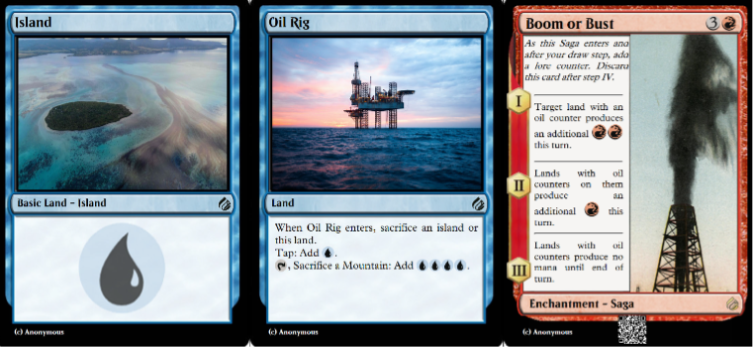
The sample deck explores the synergistic qualities of petro-capitalism as a socio-economic system, which includes aspects of production/extraction, environmental ramifications and transformation, economic implications e.g. for the automobile and related industries but also cultural implications such as consumerism and oil as a central, integrative metaphor and narrative motif.
Every M:TG deck has a ‘color identity’, i.e. one of the five colors from the iconic ‘color wheel’ or a combination of (usually not more than two or three) colors. Apart from indicating the resources required to play the respective cards, the colors evoke a fairly well-established repertoire of built-in associations that have accumulated over the 30 years of M:TG’s history and are continually performed and reaffirmed in conversations and deckbuilding practices. The sample deck frames petro culture as a combination of blue (science, technology, rationality) and red (chaos, destruction, impulsivity).
Choosing a different color identity for the topic would highlight different aspects and interpretation of petro-capitalism; for example, replacing one of the colors with black would emphasize aspects like amorality, parasitism (e.g. extracting value from communities while keeping them dependent on oil-based products and services) and decay.
Within the chosen color identity, the cards in the sample deck represent the rational, calculating aspects of petro-capitalism (blue), its destructive impact on the natural environment as well as affected communities (red) or a combination of both.
M:TG cards are differentiated into different archetypes. While these have ‘fantastical’ names within M:TG’s original lore, they represent broader concepts that allow for expressing a variety of ideas and scenarios without being limited to a specific setting or type of worldbuilding; the main card types are:
Lands represent sources of energy (mana) required to play any other cards but can also provide other resources like money (treasure/gold tokens).
Creatures represent ‘agents’ that can act offensively or defensively; these are often physical entities (creatures, machines, vehicles etc.) but can also refer to immaterial concepts. For example, existing MTG creatures include psychological dispositions like Anger, Wonder, Valor, and Glory but also immaterial phenomena like Nightmare or spirits.
Artifacts represent objects or structures that, unlike creatures, cannot attack or defend but remain in play and either have permanent effects or can be tapped/activated each turn for one-time effects (which can incur additional costs or conditions).
Enchantments represent modifications of existing cards that remain in play indefinitely or until they are (re)moved. They can affect creatures (in which case they are called auras), artifacts, lands or other cards in the game. An example of the sample deck is a ‘parking lot’ that transforms an existing land (and makes it synergize with vehicle-type artifacts or creatures).
Instants and sorceries represent any one-time action or effect; the terms just denote at which ‘speed’ they can be played (i.e. instants can also be played during the opponent’s turn).
Planeswalkers are used sparingly (as they are often rather powerful cards) and represent more fully developed characters with multiple abilities that can be used multiple times depending on an internal currency called ‘loyalty’. They remain in play similar to creatures but don’t attack or defend regularly. While there is no planeswalker card in the sample deck, the test sheet (see above) contains a sample card that demonstrates how planeswalkers can refer to anything that has ‘agency’, in this case referring to the Whanganui River that was granted legal personhood in 2017 due to its significance for the region's Māori people.
Sagas refer to short narratives, i.e. sequences of events that unfold over multiple turns. Usually, cards of the type in MTG are linear, i.e. the lore counters are added to advance through the stages of the story, and the card is discarded once the story ‘ends’. However, by manipulating lore counters or simply changing the instructions on the top of the card, sagas could hypothetically loop (think e.g. of recurring events like the seasons or elections), unfold backwards, stop and restart based on certain conditions etc.

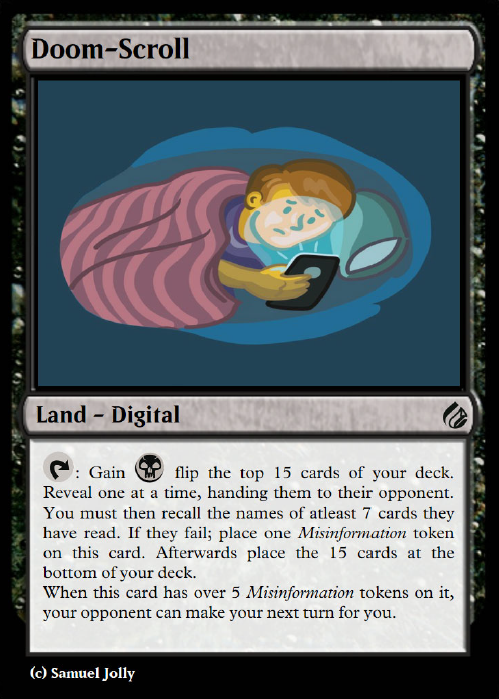
Apart from cards of different types, every deck needs cards that perform routine functions; in M:TG, these functions are semanticized as part of a duel between two rival wizards, but they can, again, easily be rethemed to represent broader concepts:
Cards that reduce the opposing players’ ‘life’, either through attacks by creatures or by directly affecting the current ‘life’ total.
Creatures that attack and defend against other creatures.
Cards that create ‘mana’ or other resources
Cards that ‘remove’ the opponent’s creatures or enchantments from the game directly.
Cards that draw from the library, either from the top or – in the case of so-called ‘tutor’ cards – searching for specific cards or cards of a specific type.
Cards that allow for retrieving removed cards from the ‘graveyard’ or ‘exile’.
This player-created list provides a more comprehensive overview of specific functions cards in M:TG can perform through predefined keywords. Explaining keywords in detail goes beyond the scope of this toolkit. Apart from using thematically related existing keywords (like e.g. ‘fabricate’ for industrial or ‘bargain’ for political contexts), experienced M:TG players may also invent their own keywords to fit the chosen theme as long as there are multiple cards in the deck that interact with that keyword and its associated game mechanic.
Apart from these routine functions, M:TG cards can have unique rules that radically change the gameplay, including e.g. cards like Coalition Victory or Mechanized Production that enable a player to instantly win the game if specific conditions are met. Some examples of such unique rules are provided below in the section ‘Inspiration for Card Design’, which can be shared with participants in the instruction phase to expand the design space and practice translating real-world phenomena into the procedural language of MTG.
Finally, every M:TG deck has one or more ‘default strategies’, i.e. characteristic play styles it affords and ways in which it allows players to win the game. For the sample deck on petro capitalism, this involves players creating and strategically moving distributing ‘oil tokens’ (a custom token type that already exists within M:TG lore) to buff their own and debuff the opponent’s cards, using vehicles to attack as well as exploiting (and thereby destroying) their own lands for a quick profit to win before the long-term loss of lands and resources catches up to them.
For an overview of basic deck types in M:TG, see https://www.dicebreaker.com/categories/trading-card-game/how-to/magic-the-gathering-deck-types-explained.
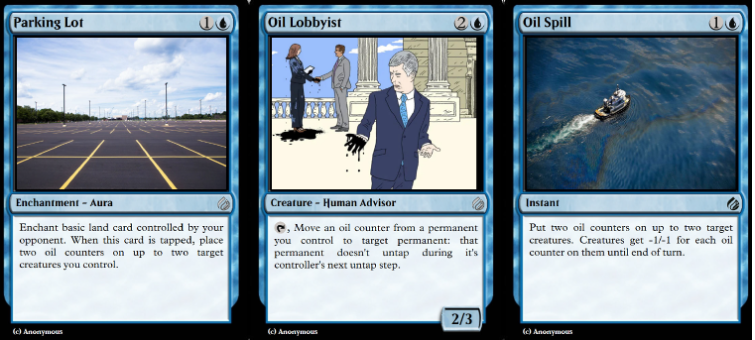
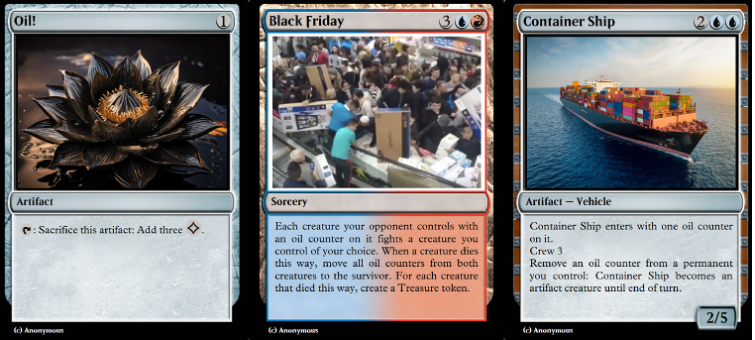
These cards from the sample deck illustrate these principles and demonstrate how well the synergistic aspects of petro-capitalism fit the gameplay of M:TG, which usually relies on ‘growing’ faster than one’s opponent(s), on deflecting the opponent’s threats at a lower cost than it took to play them and to deny the opponent the resources to do them same.
Please note:
While the M:TG Hacking Toolkit has only been tested with the game’s standard 60-card deck 1-vs-1 player format, the approach can also be adapted e.g. to MTG’s popular four-player free-for-all Commander mode or other unofficial game modes. Moreover, as the competitive premise might not be a good fit for some potential deck themes (think e.g. of decks about climate activism or hopeful climate imaginaries like Solarpunk), we are experimenting with existing (but usually niche and often more casual) cooperative variants of M:TG like Horde Magic or team-based formats like Archenemy. If these turn out to be viable, we will update the M:TG Franchise Hacking Toolkit to incorporate these additional formats and provide custom decks to demonstrate how to use them.
For an overview of MTG formats, see e.g. https://en.wikipedia.org/wiki/Magic:_The_Gathering_formats.
Inspiration for Card Design
This section showcases selected cards from the 30-year history of M:TG, which represent fictional, often fantastical scenarios but also demonstrate how the procedural vocabulary of M:TG can be used to express ideas and tell stories, in a single card or through a combination of interoperable cards.
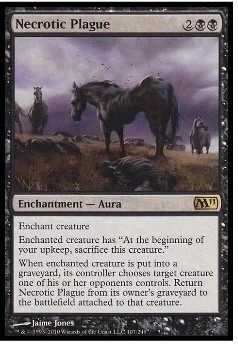
Necrotic Plague symbolizes an epidemic through a unique rule that equally affects the player ‘casting’ it and their opponent(s). In this case, the destructive aura alternately targets and kills the respective other’s (or others’) creatures. The way the rule is formulated, the plague can only be contained if the enchantment is removed through another card or if there are no remaining creatures in play, in which case the plague ‘dies’ together with its last host.
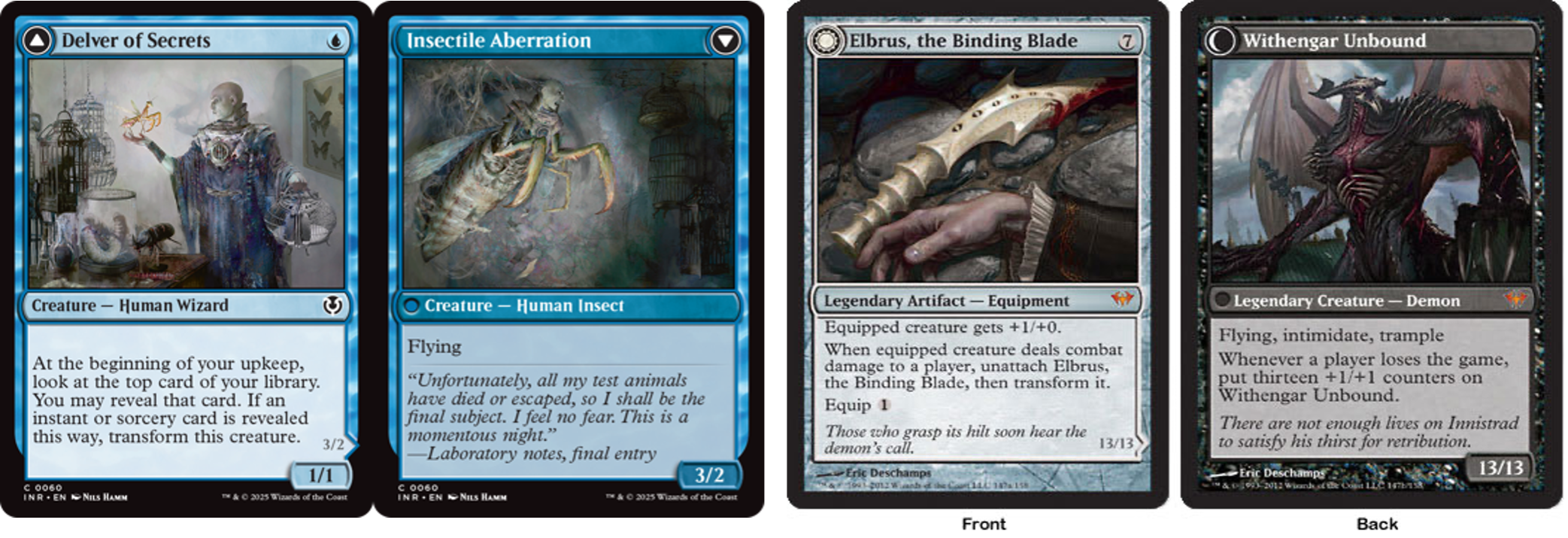
Delver of Secrets and Elbrus, the Binding Blade showcase how cards of basically any type (in this case a creature and an artifact) can have a built-in emergent narrative by virtue of being double-sided, i.e. flipping to an entirely different card (and, potentially, back) when a certain condition is met. For example, the Delver of Secrets clearly alludes to the 1986 horror movie The Fly, in which a scientist slowly transforms into an insect due to a failed experiment.
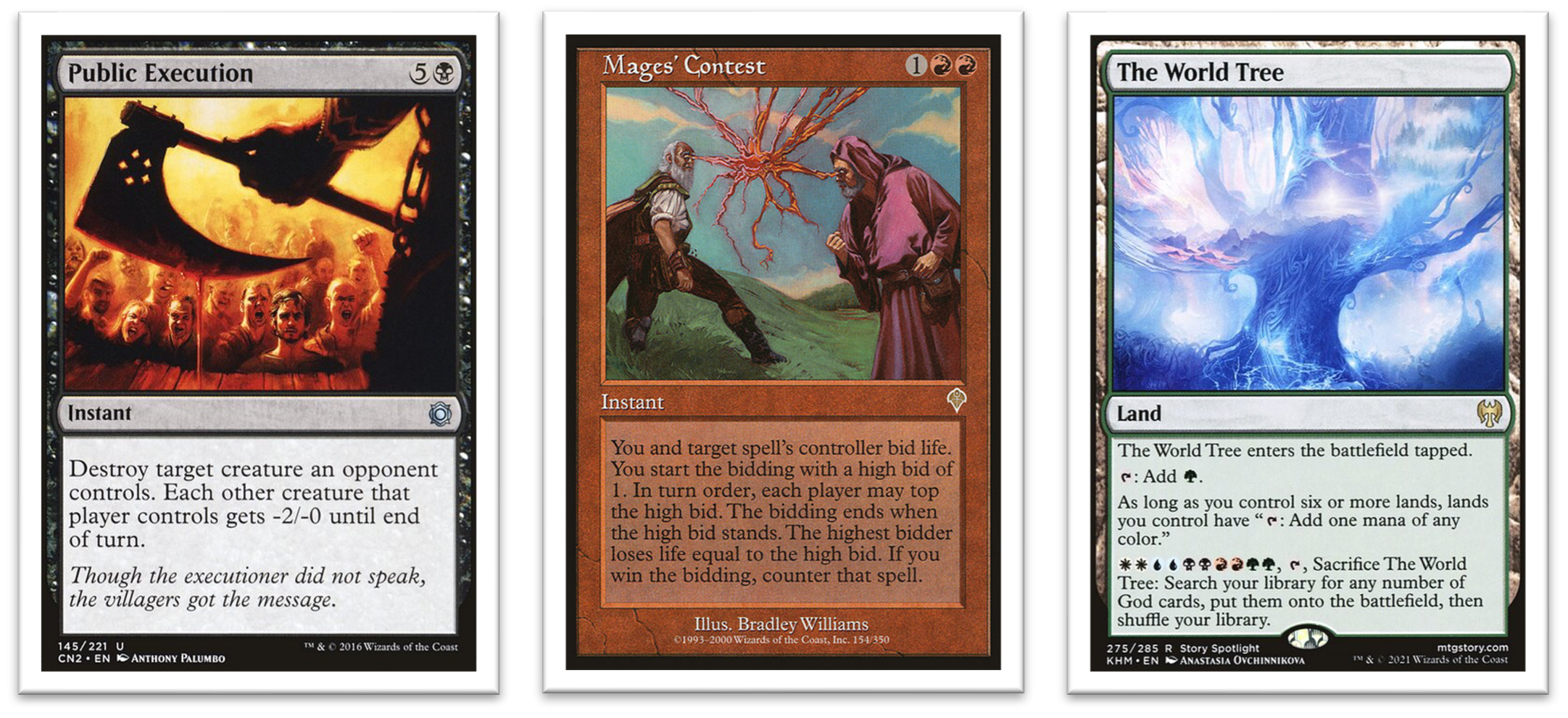
Public Execution is an example of a card in which the flavour text (in italics) explains the otherwise seemingly arbitrary rule on the card; in this case, it explains how the execution ‘paralyzes’ all bystanders with fear, thus temporarily reducing their power. Mages’ Contest works similarly to Fact or Fiction in that it incorporates a game mechanic otherwise not present in MTG, in this case an auction/bidding system. The World Tree demonstrates how usually ‘static’ land cards can comprise emergent narratives by having multiple abilities tied to increasingly difficult conditions. Therefore, over the course of a game session, the card seemingly ‘evolves’ over time in response to a changing board state.
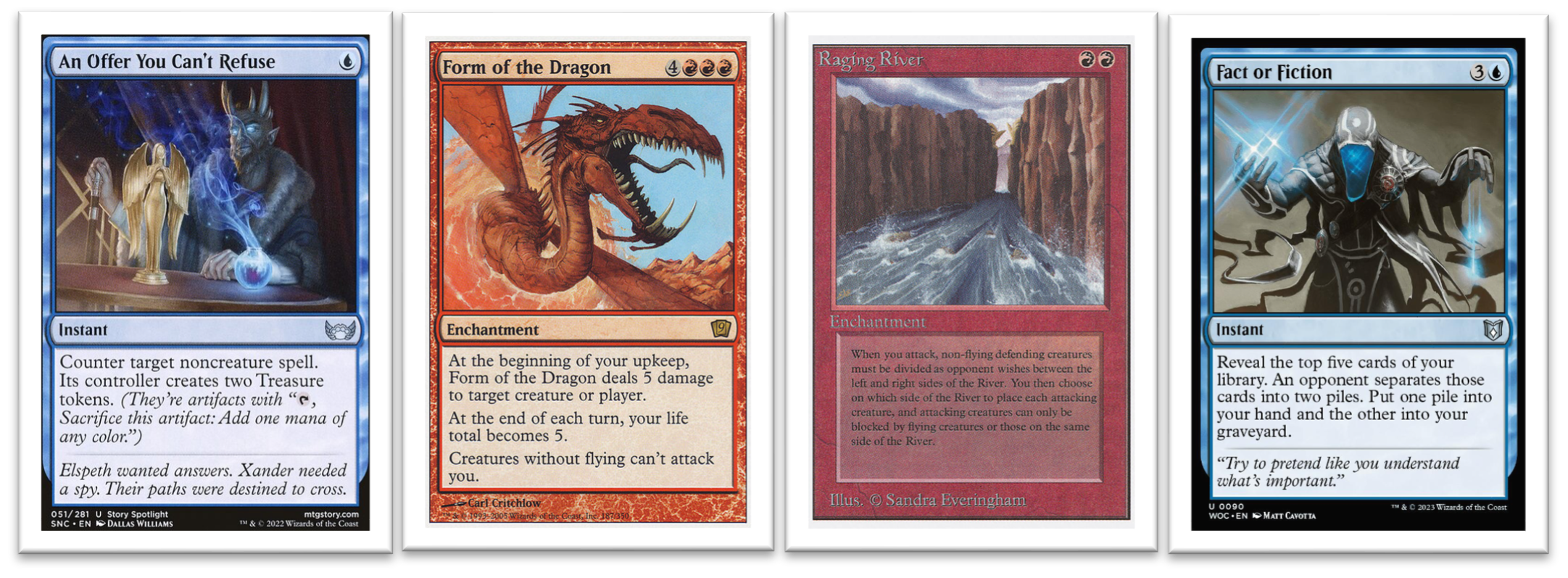
An Offer You Can’t Refuse represents the ambiguity of political intrigue by making the card ‘cheap’ but partially compensating the opponent for their loss in return. Raging River and Fact or Fiction exemplify that MTG cards can be extended with any arbitrary rule as long as they use the basic components of the game. For example, Fact or Fiction implements a common board game mechanic, I Cut You Choose, that is usually not part of MTG’s core gameplay.
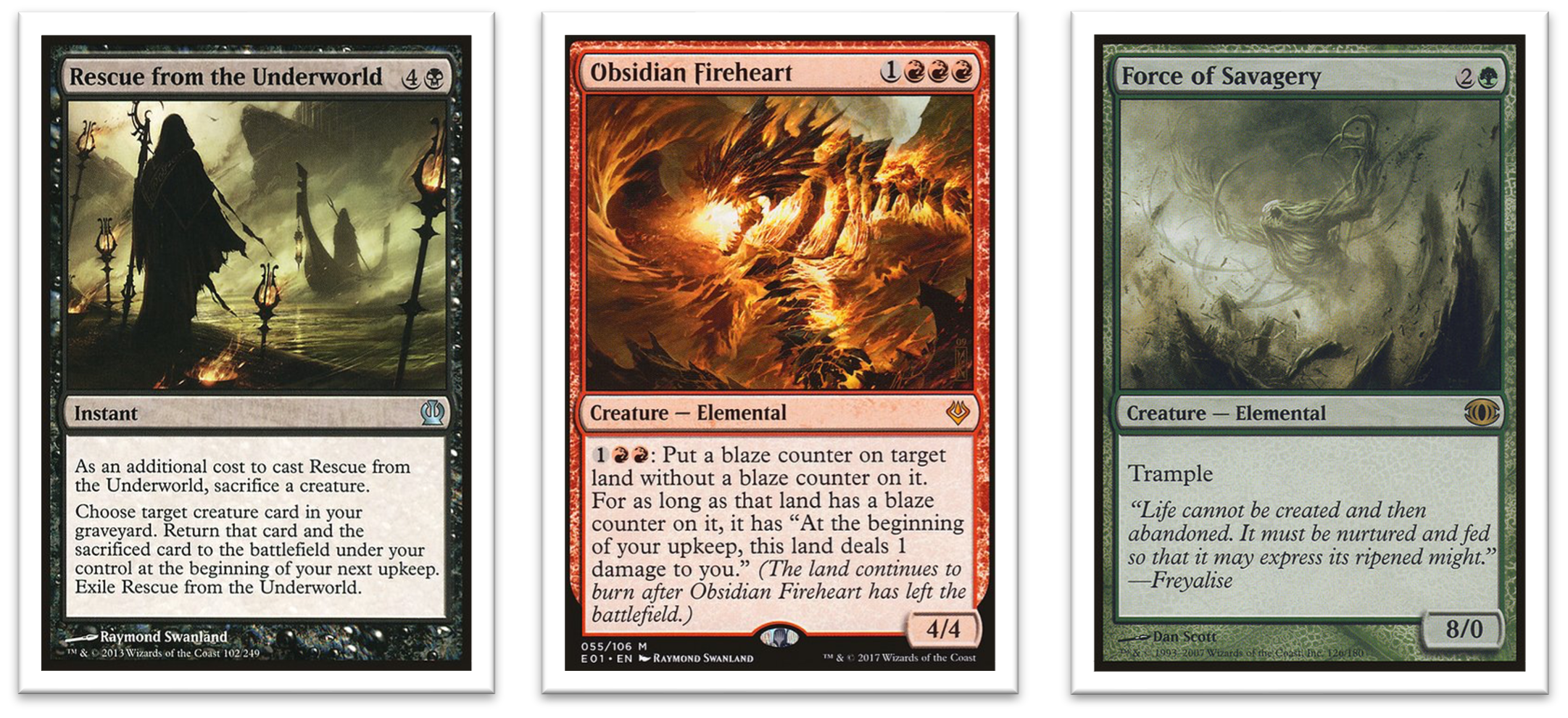
Rescue from the Underworld uses MTG’s ‘graveyard’ feature to evoke the myth of Orpheus and Eurydike, having a creature temporarily ‘die’ and returning it together with another creature from the graveyard a turn later. Obsidian Fireheart symbolizes a forest fire ravaging a player’s land; the additional rule in italics, indicating that the burning continues indefinitely, is unique to this card. Force of Savagery symbolizes the fragility of nature by rendering it as a powerful creature which, however, would die immediately without any buff due to having 0 toughness.
Bibliography
Bainbridge, Jason. 2014. ‘“It Is a Pokémon World”: The Pokémon Franchise and the Environment’. International Journal of Cultural Studies 17, no. 4: 399–414. https://doi.org/10.1177/1367877913501240.
Fluitsma, Timo. 2024. Franchise Hacking – Magic: the Gathering. Available from: https://gameresearch.nl/2024/04/franchise-hacking-magic-the-gathering/
Gee, James Paul. 2017. ‘Affinity Spaces and 21st Century Learning’. Educational Technology 57, no. 2: 27–31.
Germaine, Chloé and Wake, Paul. 2025. Curious Games: Game Making, Hacking and Jamming as Critical Practice. Behav. Sci. 15, 1415. https://doi.org/10.3390/bs15101415
Germaine, C. & Wake, P. 2026. Game Hacking Education Report. STRATEGIES: Sustainable Transition for Europe’s Game Industries. Available at: https://www.strategieshorizon.eu/reports
Johnson, Derek. Media Franchising. Creative License and Collaboration in the Culture Industries. New York University Press, 2013.
Werning, Stefan. 2021. ‘Ecomodding. Understanding and Communicating the Climate Crisis by Co-Creating Commercial Video Games’. Communication +1 8 (1). https://scholarworks.umass.edu/cpo/vol8/iss1/7/