New STRATEGIES Reports Published: Emerging Technologies, Sustainability, and the Future of Game Development
STRATEGIES is pleased to announce the publication of four new research reports exploring how immersive technologies, artificial intelligence, and innovative pedagogical methods can support a sustainable transition for Europe’s game industries.
Together, these reports address STRATEGIES’ central missions: (1) Reducing the environmental footprint of game production and play and (2) strengthening the transformative cultural potential of games to support environmental awareness, critical literacy, and ecological shared futures.
Each report is now available to download here.
Report 1: VR for Sustainability
Virtual reality has emerged as an engaging medium for environmental education, public engagement and imaginative worldbuilding. This report maps the global landscape of VR experiences and institutions working at the intersection of immersive technology and sustainability. Our researchers provide a historical and conceptual overview of VR and XR and a catalogue of more than 50 sustainability‑focused VR experiences, ranging from ocean conservation to forest literacy to the Overview Effect. They analyse these experiences to provide insights into how VR can support environmental literacy, behaviour change, and systems thinking. However, the tensions of adapting technological innovation for sustainability-oriented action are not ignored. The report offers a critical discussion of barriers to VR for sustainability, including methodological challenges, the issue of access to VR experiences, and the environmental impacts of VR technologies themselves.
This report demonstrates how VR can help learners and audiences understand environmental issues at emotional, experiential, and conceptual levels while offering guidance for socially and ecologically responsible use.
Report 2: AI, Game Development and Sustainability
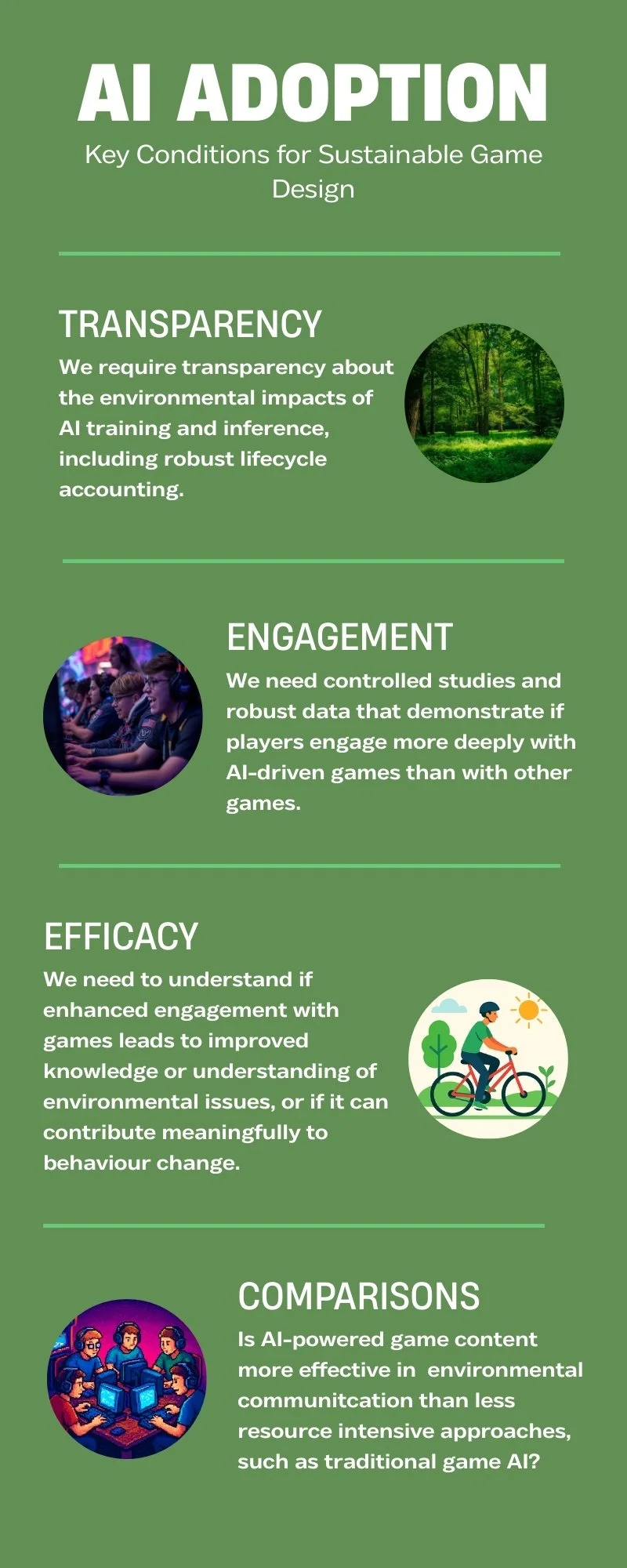
With media reports and industry surveys suggesting that AI tools are become increasingly integrated into game development workflows, this report offers a timely and evidence‑based examination of their environmental and climate‑justice implications. Our researcher provides a clear explanation of different types of “AI”, distinguishing traditional game AI from energy‑intensive generative systems in order to burst the AI “hype” bubble. The report also surveys recent data and literature analysing the material infrastructures that underpin AI, including data centres, compute growth, hardware lifecycles, and water usage. From this, our researcher synthesizes key takeaways about energy consumption, carbon emissions, e‑waste and transparency gaps in current AI industry practices on reporting these environmental impacts. Another dimension of the research focuses on climate justice issues, labour exploitation, and the geopolitical implications of AI infrastructure expansion. Finally, we offer recommendations to support responsible, accountable and sustainable AI adoption in Europe’s game industries.
The report equips game development studios, educators and policymakers with the knowledge required to make informed decisions about AI integration, cutting through hype to focus on ecological realism.
Report 3: AI in Board Game Design and Development
Artificial intelligence is reshaping analogue and hybrid game design as much as digital game production. This report extends STRATEGIES’ sustainability analysis into the tabletop domain to explore AI‑supported board game design methods. Alongside considering good-old-fashioned Paper‑AI systems for solo play across the tabletop, the research shows how designers are beginning to use generative tools in rule writing, narrative development, and component creation. Our researcher also provides a snapshot of current AI disclosure trends on crowdfunding platforms, analysing current attitudes across designer and players, as well as of hybrid AI‑enabled platforms and the sustainability questions they raise.
Drawing on a significant corpus of board games and platform data, the report demonstrates that accountability, transparency, and environmental responsibility are equally important in analogue game cultures.
Report 4: Game Hacking Education Report
Game hacking, the practice of reimagining and transforming existing games, offers a powerful, low‑impact method for teaching sustainability and critical literacy. This report outlines the pedagogical rationale, ethical considerations, and practical approaches for embedding hacking into higher education curricula.
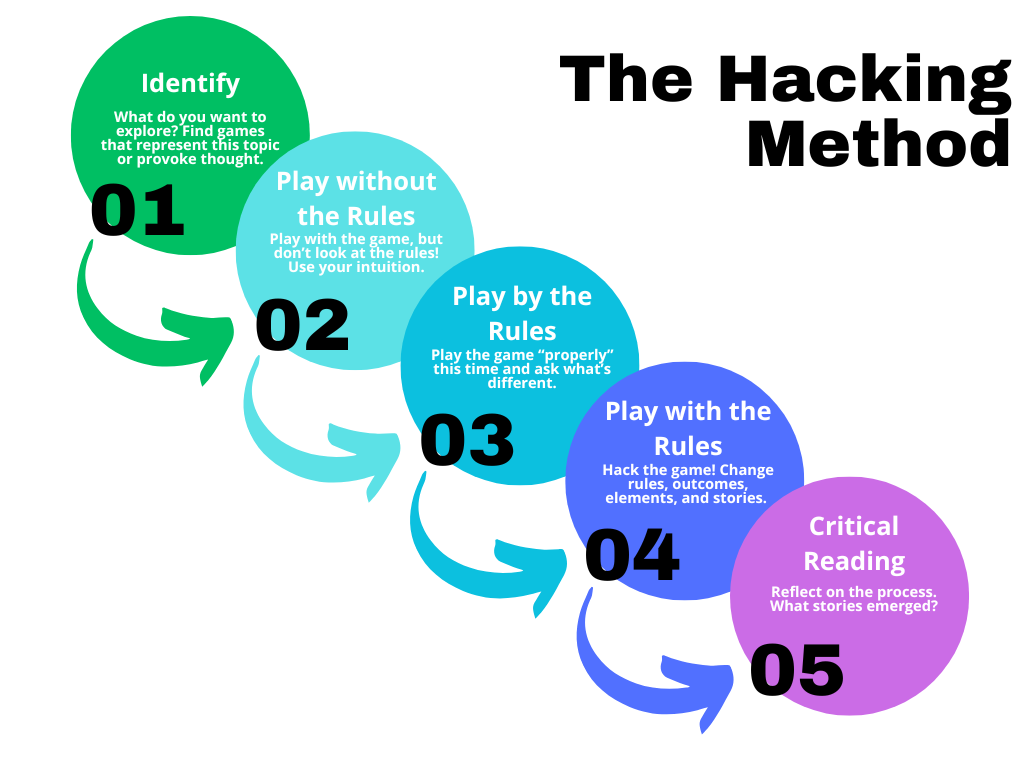
The “hacking” method devised by Germaine and Wake
It includes:
A clear definition of hacking as a critical‑creative design method;
A five‑stage process that supports reflective, hands‑on learning;
Case studies from university courses, research workshops, and public engagements;
Guidance on safeguarding, inclusivity, accessibility, and intellectual property;
Recommendations for integrating hacking into game design programmes.
Crucially, the hacking approach models circular design principles by encouraging the reuse and repurposing of existing materials, rather than producing new games or consumable goods.
A Shared Commitment to Sustainable Futures in Game Production and Play
Across all four reports, a clear message emerges: game development must be reimagined through the lens of sustainability, justice, and accountable technological innovation. Whether through immersive storytelling, critical pedagogies, or careful evaluation of digital infrastructures, Europe’s game industries have an essential role to play in shaping ecological futures.
We invite developers, educators, researchers, policymakers and players to explore the full reports and join us in advancing a more sustainable game sector. Please contact us with your ideas about how to advance the research in these reports. We’re open to collaboration on future research activity.