Hack the Games You Know: Two Free Toolkits from STRATEGIES
We are pleased to launch our two free toolkits to help educators, students, designers and players to use hacking as a creative way to explore game design. These are the Ecogame Hacking Toolkit and the Franchise Hacking Toolkit.
Both toolkits grow out of research and activity at the Manchester Game Centre and the Utrecht Center for Games Research around game hacking as a research and teaching method conducted as part of STRATEGIES. The toolkits put into practice the approach that Chloé and Paul Wake set out in our Game Hacking Education Report and have been designed to be picked up and used straightaway in multiple contexts, including classrooms, higher education, workshops and in climate communication.
Why Hack Games?
Games are not a neutral medium. Their rules and stories carry assumptions about how the world works and encode values and ideologies. For example, that competition is a natural state, that the natural world exists as resources to be exploited, or that growth and expansion are good. Hacking exposes these assumptions and values by changing games - breaking or bending the rules, inventing new rules, swapping components, transforming the win conditions, and so on - and then asking us to play them again to see what has shifted.
Even small hacks can reveal a lot about the hidden assumptions in games. When we kept every rule of the popular board game, Photosynthesis, the same, only changing the components from trees to tanks, we discovered that it worked as a perfect wargame. The gentle tree imagery and nature theme had worked to naturalise ideas of ruthless competition, scarcity and territory domination.
Hacking games can foster much-needed discussion about what needs to change in society, about new sustainability-oriented narratives and about how we might do game design differently. It’s also working with materials we already have, favouring reuse and recycling over consumption of new games.
The Ecogame Hacking Toolkit
This is a free library of 3D board game assets with environmental themes, ready to load into a virtual tabletop. You can use them to reskin a game you know well, test new rules and prototype game hacks with players around the world.
The assets were designed by School of Digital Arts students in Manchester, and developed with STRATEGIES partner, Plasticity Studios, creator of the virtual tabletop, Tabletop Playground. To help you get started with our toolkit, we’re offering 100 free codes for the full release of Tabletop Playground.
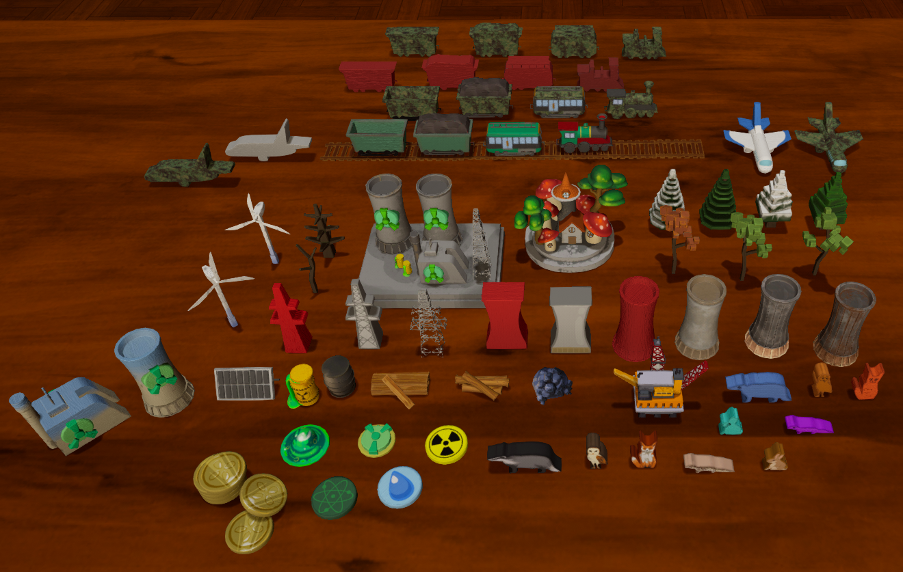
Assets made for virtual tabletop environments in our ecogame hacking toolkit.
The Franchise Hacking Toolkit
This toolkit uses the familiar cards, rules and keywords of Magic: The Gathering as a starting point for critical design and play. Developed in workshops at the Utrecht Game Lab, Manchester Metropolitan University and the UK Games Expo, the method of franchise hacking has proved generative of conversations around sustainability futures with many different audiences.
You can use the toolkit to generate you own, new M:TG decks and play these with friends. Again, we encourage online collaboration with players anywhere in the world.
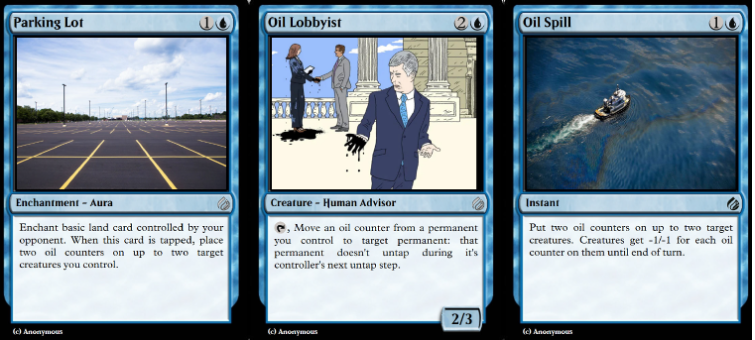
Sample M:TG Cards made in our Franchise Hacking Workshops
Who are the Toolkits For?
The toolkits are for anyone curious about how games shape the way we see the world:
Educators looking for a hands-on way to teach game design, climate communication or sustainability.
Students and designers who want to understand how rules and mechanics carry meaning, and to practice designing with ethical and environmental issues in mind.
Players and activists who want to question and remake games, starting conversations and promoting climate action among their communities.
No technical skills are needed to use our toolkits and hacking doesn’t mean you have to make a final, polished game. Messy, unfinished and surprising hacks are often the most effective.
To find out more about hacking as a method, explore our toolkits, read the game hacking education report, and check out our published research on the theory behind our work.